
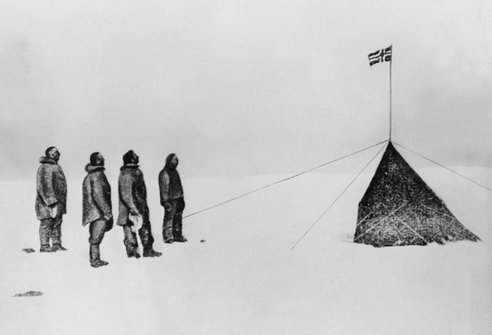
The race to the South Pole demonstrates that effective leadership is not simply about determination or ambition, but about preparing people, systems and decisions for the conditions they will actually face. At Now & Co, the same principle applies to sales leadership, where preparation can determine how effectively a team responds when the pressure increases.
More than a century ago, two teams travelled towards one of the most inhospitable places on Earth with the same objective: to become the first to reach the geographic South Pole.
The Norwegian expedition was led by Roald Amundsen, while the British expedition was led by Robert Falcon Scott. Both men were experienced explorers, both had ambitious teams behind them and both were willing to undertake an extraordinary level of risk to achieve their objective.
Yet their journeys produced very different outcomes.
Amundsen reached the South Pole first and successfully returned to base with his team. Scott reached the Pole several weeks later, only to discover that Amundsen had beaten him there, and his polar party subsequently died during the return journey.
The story is often remembered as a race, but there is a much more valuable lesson for modern businesses hiding within it.
Why was preparation so important to Amundsen’s success?
Amundsen’s preparation focused heavily on matching his strategy, equipment and team to the environment they were entering.
Before and during his expedition, Amundsen drew on experience he had gained from previous exploration, including learning from Indigenous Arctic communities about clothing, dog handling and methods of travelling through extreme environments. His South Pole expedition also made extensive use of skis and sled dogs, with equipment adapted and tested before the main journey.
This is an important distinction in leadership because preparation is not simply about having more resources. It is about understanding which resources are actually useful for the challenge ahead.
A leader can have an incredibly talented team, significant ambition and a clear target, but if the people, processes and preparation do not match the environment they are operating in, those advantages can quickly become less valuable.
What does the South Pole teach us about leadership?
The South Pole story shows that leadership is partly the ability to anticipate problems before they become problems.
Amundsen’s expedition established supply depots along the route, carefully considered transportation and travelled with people who had strong skiing experience. The expedition was designed around the realities of Antarctic travel rather than simply relying on determination to overcome them.
That principle translates directly into modern leadership.
In sales, preparation might mean ensuring that a new team member understands the campaign before entering the field, providing regular coaching, understanding territory management, reviewing conversion rates and giving people the opportunity to practise conversations before they are expected to handle them independently.
Preparation gives people something to fall back on when confidence disappears.
How does preparation affect sales performance?
Preparation improves sales performance by giving salespeople a clear process to rely on when customer conversations become unpredictable.
Face to face sales is naturally dynamic because every customer brings a different personality, question, objection and expectation to the conversation. A salesperson therefore needs more than a script; they need enough understanding and experience to adapt their approach while remaining aligned with the campaign objective.
At Now & Co, this is where training and coaching become particularly important because the purpose of preparation is not to remove uncertainty from the field. It is to make the team better equipped to respond to it.
A well prepared salesperson can listen more effectively, ask better questions and respond to objections without losing sight of the conversation they are trying to create.
What can leaders learn from the difference between Amundsen and Scott?
The biggest leadership lesson is that wanting the outcome is not the same as preparing for the journey required to achieve it.
Ambition is important, but ambition without preparation can create unnecessary pressure when circumstances change.
There are three areas where this matters particularly strongly in sales leadership:
1. Prepare the people
A strong sales team needs more than targets. People need training, coaching, feedback and the opportunity to develop their skills through real experience.
2. Prepare the process
A clear sales process gives people consistency while still allowing them to adapt to the individual customer and situation.
3. Prepare for what could go wrong
Great leaders do not assume that everything will go according to plan. They think about objections, setbacks, changes in performance and unexpected circumstances before they occur, allowing their teams to respond rather than react.
Does preparation mean everything has to go perfectly?
No, effective preparation does not guarantee that everything will go according to plan; it increases the team’s ability to respond when something does not go according to plan.
This is perhaps the most useful lesson to take from the South Pole story.
No expedition could control the Antarctic weather, the terrain or every difficulty that appeared along the route. The difference was in how each team prepared to operate within those conditions.
The same is true in business.
You cannot control every customer.
You cannot control every market condition.
You cannot guarantee that every campaign will perform exactly as expected.
What you can control is how well your people understand their role, how effectively they are trained, how frequently they receive feedback and whether your leadership has prepared them for the challenges they are likely to encounter.
What does this mean for leaders today?
Good leadership is not simply about pushing a team towards a destination; it is about making sure the team is properly equipped for the journey.
At Now & Co, our approach to sales development is built around the belief that performance is developed through preparation, coaching and experience. When teams are actively working in the field, the lessons become real, the feedback becomes practical and the development process becomes much more relevant to the challenges people actually face.
The South Pole was reached by two teams, but the journeys were very different.
That is an important reminder for any leader who has a big objective in front of them.
The destination might be the same, but the preparation determines how ready your team is for the journey.
And sometimes, the biggest difference between success and failure is not who wanted it more.
It is who was better prepared for what came next.
#Leadership #SalesLeadership #SalesTraining #TeamDevelopment #FaceToFaceSales #NowAndCo
